ZiggyStarClaw: A Lightweight, Cross-Platform OpenClaw Client in Zig
· 6 min read
· Deano
In the rapidly evolving landscape of AI-powered personal assistants, OpenClaw has emerged as a powerful open-source framework for running autonomous agents locally. It provides a robust architecture for routing messages, managing agent lifecycles, and interacting with a variety of platforms. The official OpenClaw clients are built on Node.js, offering a flexible and widely adopted JavaScript runtime environment. However, for developers who prioritize performance, minimal resource consumption, and a desire to work closer to the metal, an exciting new alternative has arrived: ZiggyStarClaw.
This post introduces ZiggyStarClaw, a from-scratch implementation of an OpenClaw operator and node client, written entirely in the Zig programming language. We will explore its architecture, its advantages over the official Node.js implementation, and how you can get started with this lean, mean, lobster-themed machine.
What is OpenClaw?
Before diving into ZiggyStarClaw, it is essential to understand the ecosystem it inhabits. OpenClaw is a self-hosted agent runtime that acts as a central Gateway. This gateway connects to various messaging platforms (like WhatsApp, Telegram, and Slack) and exposes a WebSocket API. Clients, known as Operators (for control) and Nodes (for peripheral capabilities), connect to this gateway to send commands, receive messages, and extend the AI agent's functionality.
The official clients are built with TypeScript and run on Node.js, which provides a rich ecosystem and asynchronous capabilities. However, this comes with the overhead of the Node.js runtime, a larger memory footprint, and dependencies that can be cumbersome for system-level integrations or resource-constrained environments.
Enter ZiggyStarClaw: The Zig Alternative
ZiggyStarClaw was born out of a desire for a more lightweight and performant client. As its name playfully suggests—a nod to Zig and a cosmic crustacean—it is an alien alternative to the mainstream, designed for developers who appreciate the elegance and power of systems programming.
Built with Zig, a modern language that rivals C in performance while offering memory safety and a powerful compile-time feature set, ZiggyStarClaw provides a native, dependency-free experience. It connects directly to the OpenClaw Gateway's WebSocket, speaking the same protocol as the official clients but without the baggage of a JavaScript runtime.
The OpenClaw Ecosystem with ZiggyStarClaw
The following diagram illustrates where ZiggyStarClaw fits into the broader OpenClaw architecture. It acts as a peer to the official clients, offering the same core functionality but with a different technological foundation.
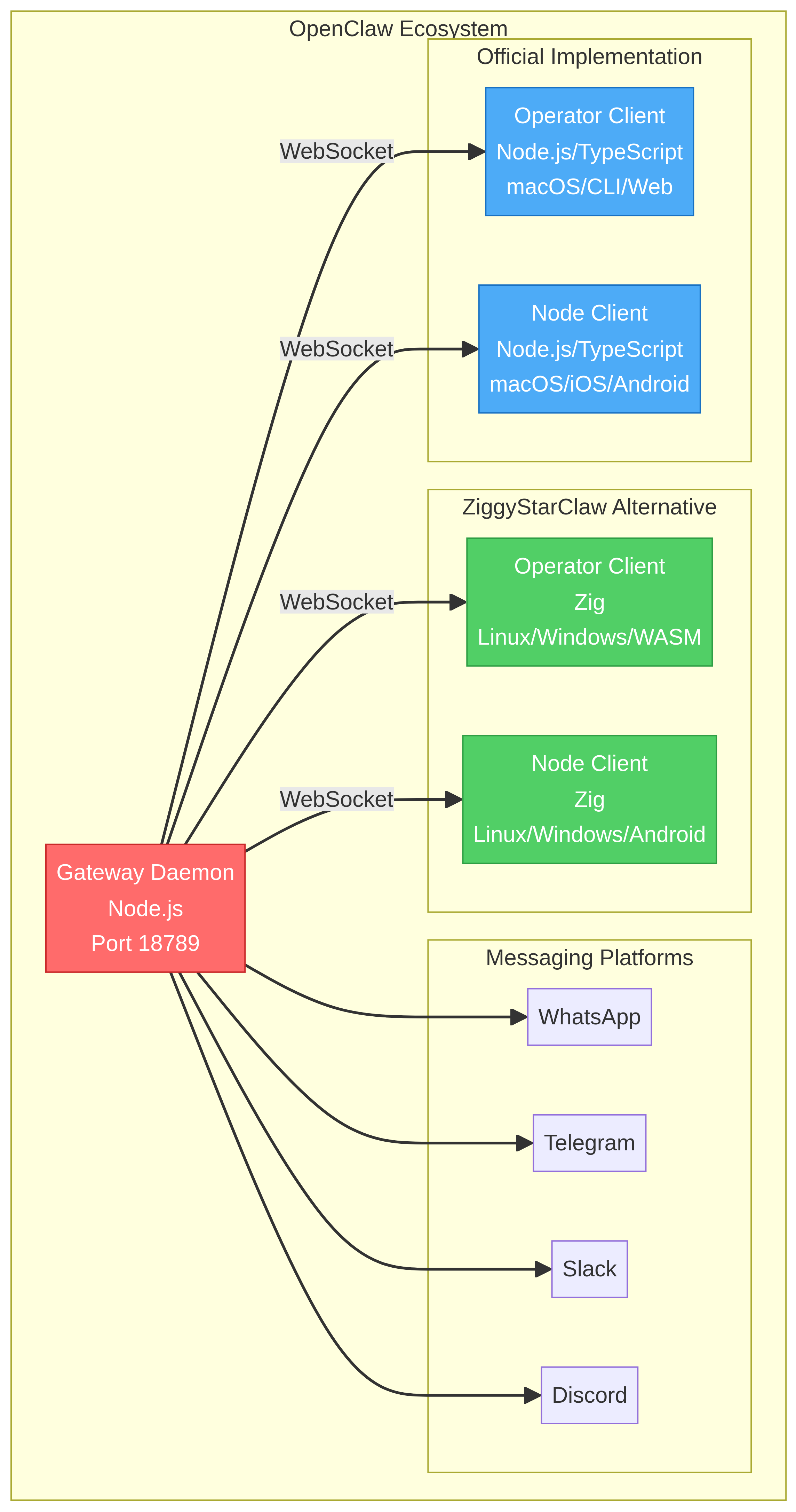
As shown, both the official clients and ZiggyStarClaw communicate with the central Gateway, which in turn manages the connections to external messaging platforms. This allows users to choose the client that best fits their technical preferences and performance requirements without sacrificing access to the core OpenClaw functionality.
Key Advantages of ZiggyStarClaw
Choosing a client built in a systems programming language like Zig offers several distinct advantages over a Node.js-based solution:
| Feature | ZiggyStarClaw (Zig) | Official Client (Node.js) |
| Binary Size | Very small, self-contained executables | Large, requires Node.js runtime and node_modules |
| Memory Footprint | Minimal, due to manual memory management | Higher, due to V8 engine and garbage collection |
| Startup Time | Nearly instantaneous | Slower, requires Node.js process initialization |
| Dependencies | None at runtime | Requires Node.js and npm/yarn package manager |
| Cross-Compilation | Native, first-class support for multiple platforms | Can be complex, often requires platform-specific builds |
| Resource Usage | Highly efficient, ideal for embedded or constrained systems | Less suitable for low-power or resource-limited devices |
These benefits make ZiggyStarClaw an excellent choice for users running OpenClaw on a small home server, a Raspberry Pi, or even as a WebAssembly (WASM) module in a browser, where every megabyte and millisecond counts.
A Look Inside: The Architecture of ZiggyStarClaw
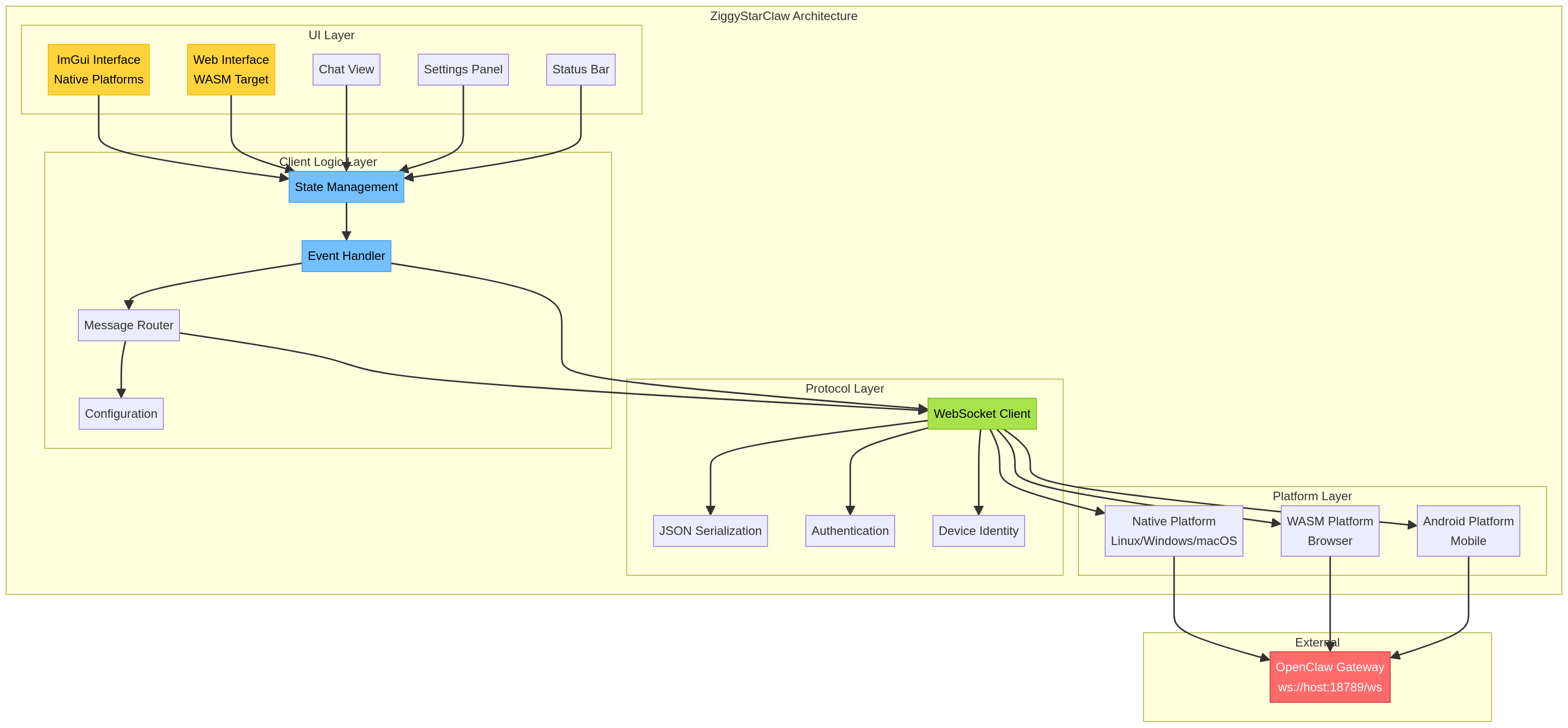
ZiggyStarClaw is designed with a clean, layered architecture that separates concerns and promotes modularity. This makes the codebase easy to understand, maintain, and extend.
The Connection Flow
Connecting to the OpenClaw Gateway involves a specific sequence of events, including a handshake and an optional device pairing step. The diagram below outlines this process.
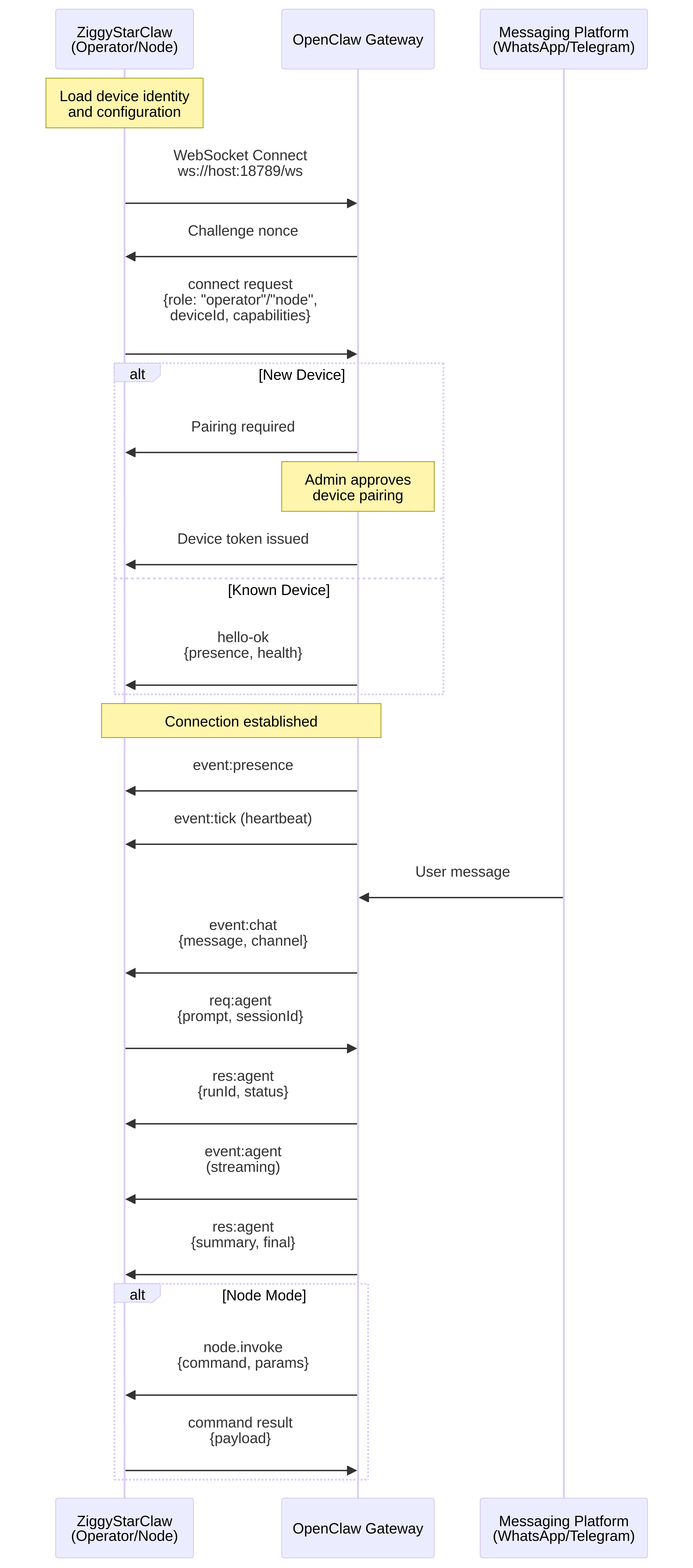
When ZiggyStarClaw first connects, it presents its unique device identity. If the gateway does not recognize this ID, it initiates a pairing process that requires approval from an administrator. Once approved, the gateway issues a token that ZiggyStarClaw stores for future connections, streamlining the authentication process.
Getting Started with ZiggyStarClaw
Building and running ZiggyStarClaw is straightforward, thanks to Zig's integrated build system. You will need to have the Zig compiler (version 0.15.1 or newer) installed on your system.
First, clone the repository:
bash
gh repo clone DeanoC/ZiggyStarClaw
cd ZiggyStarClaw
Next, fetch all package dependencies:
bash
zig build --fetch
Then build the native executable for your platform:
bash
zig build
Finally, run the application:
bash
zig build run
ZiggyStarClaw can also be compiled to WebAssembly for use in a web browser. For detailed instructions on WASM builds and other platform targets, please refer to the project's
README.md file.Conclusion: A New Frontier for OpenClaw Clients
ZiggyStarClaw represents more than just an alternative client; it is a testament to the power and flexibility of modern systems programming languages like Zig. By offering a lightweight, high-performance, and cross-platform solution, it opens up new possibilities for how and where developers can run their OpenClaw agents.
Whether you are a game developer looking to integrate AI into your projects, a hobbyist running a home server, or simply a developer who appreciates finely crafted software, ZiggyStarClaw provides a compelling reason to explore the world beyond Node.js. As the project continues to evolve, it promises to bring even more of OpenClaw's powerful node capabilities to its lean and efficient Zig-based core.
---
References
---
Document Version: 9.0 - 2026-02-03